
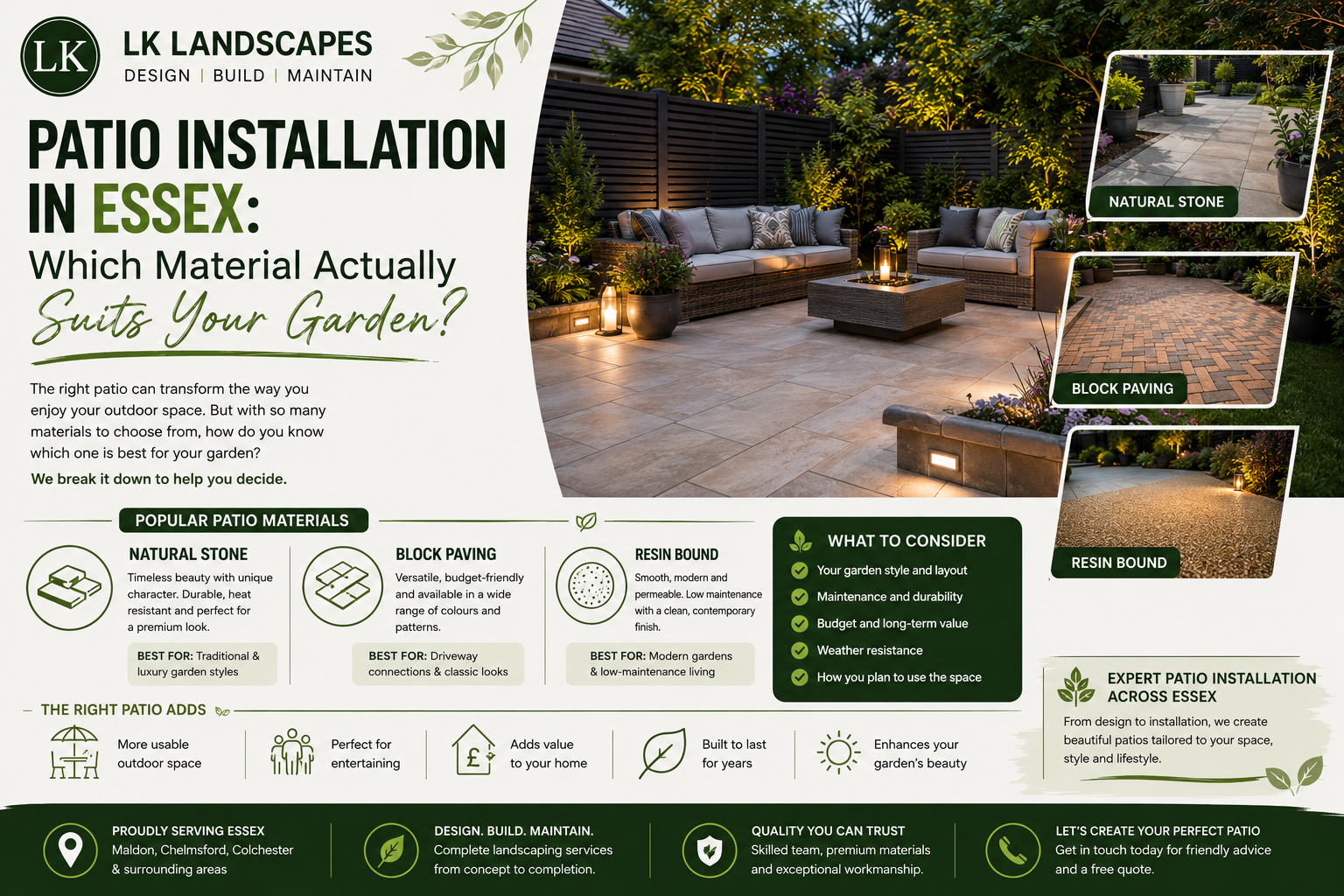
A patio is the part of the garden that gets used the most, so getting the material right matters more here than almost anywhere else outside. Homeowners across Heybridge, Tollesbury and Tiptree usually narrow it down to three options: porcelain, Indian sandstone or block paving. Each behaves differently once it has weathered a few Essex winters.
This guide covers what each material is actually like to live with, the groundwork that determines whether a patio lasts, and how to plan paths that connect it to the rest of the garden.
Porcelain Paving: Low Maintenance, Consistent Finish
Porcelain is manufactured, not quarried, which means every slab looks the same and stays that way. It does not stain easily, resists frost damage well, and needs almost no sealing or ongoing treatment.
It costs more per square metre than natural stone and needs a skilled, level installation, since any unevenness in the base shows more on a rigid porcelain slab than on natural stone.
Why Porcelain Handles Frost So Well
Porcelain is fired at extremely high temperatures during manufacture, which gives it very low water absorption, typically under 0.5 percent. Since frost damage happens when absorbed water freezes and expands inside a stone’s pores, porcelain’s low absorption rate is what makes it so resistant to the freeze-thaw cycles common in Essex winters. Natural stone, by comparison, absorbs more moisture and is more exposed to this kind of long-term wear.
Porcelain Thickness and Where It’s Used
Outdoor porcelain paving is generally supplied at 20mm thickness, roughly double the thickness of indoor porcelain tiles, specifically to handle foot traffic, furniture and occasional vehicle access without cracking. This thicker format also allows porcelain to be laid on a pedestal system for raised, drainage-friendly patios, an option not typically available with natural stone or block paving.
Indian Sandstone: Natural Texture, Some Upkeep
Sandstone remains one of the most popular patio choices in the UK for its natural colour variation and texture. It is more affordable than porcelain and has a warmer, less uniform look that suits period properties particularly well.
The trade off is porosity. Sandstone can absorb moisture and stain more easily than porcelain, so periodic sealing helps keep it looking sharp, and green algae can build up in shaded, damp corners without occasional cleaning.
Calibrated vs Riven Sandstone
Sandstone is sold either riven, meaning it retains its natural, uneven quarried surface texture, or calibrated, meaning the underside has been machine-finished to a consistent thickness for easier, faster laying. Calibrated riven sandstone, which combines a natural top texture with a flat, even base, is now the most common specification for domestic patios since it offers the best balance of appearance and ease of installation.
Sealing Sandstone Properly
A quality sandstone sealant, applied after the patio has fully cured, reduces staining from spilled food, drink, oil and general garden debris, and slows algae growth in shaded areas. Resealing every two to three years is typical, though south-facing, sun-exposed patios tend to need this less often than shaded, north-facing areas that stay damp for longer after rain.
Block Paving: Cost Effective, Highly Flexible
Block paving works well for paths and patios that connect to a driveway, since the same material can run seamlessly from the front of the property to the back garden. It is generally the most budget-friendly of the three and holds up well to foot traffic. For a fuller comparison of block paving against other surfacing options, our guide to driveways in Essex covers durability and cost in more depth.
Material Comparison
| Factor | Porcelain | Indian Sandstone | Block Paving |
| Relative cost | Higher | Mid | Lower to mid |
| Staining risk | Low | Moderate | Low to moderate |
| Natural texture | Uniform | High variation | Uniform |
| Sealing needed | Rarely | Recommended | Occasional |
| Frost resistance | Excellent | Good | Good |
| Slip resistance (wet) | Good, textured finishes available | Moderate | Moderate |
Getting the Base Right
Whatever surface is chosen, the sub-base and drainage fall are what determine whether a patio stays flat and puddle-free for the next twenty years. A patio laid too close to the damp course, or without a slight fall away from the house, is one of the most common issues we get called out to fix on other companies’ work.
The Standard Patio Build-Up
A well-built patio typically starts with excavation to remove topsoil and organic material, followed by a compacted sub-base of at least 100mm of MOT Type 1 stone, a bedding layer of sharp sand and cement mix, and the paving slabs laid on top with a consistent fall, usually around 1 in 60 to 80, directed away from the house. Skipping or thinning any of these layers is what causes the sinking, cracking and puddling problems that show up within a few years rather than decades.
Damp Proof Course Clearance
Building regulations require finished patio level to sit at least 150mm below the property’s damp proof course, and this is one of the most commonly overlooked rules on DIY or budget patio jobs. Getting it wrong risks rising damp inside the house, which is a far more expensive problem to fix than the patio itself.
Paths That Connect the Garden
A path does the same job as a patio but for movement rather than sitting. Matching path materials to the patio, and to a nearby driveway, keeps a garden feeling designed rather than patched together over time. Paths also pair naturally with garden construction work such as raised beds, steps or retaining walls where levels change across the plot.
Path Width and Layout Guidance
A single-person path is generally comfortable at 600mm to 900mm wide, while a path meant for two people walking side by side, or one that needs to accommodate a wheelbarrow or mower, works better at 1.2 metres or more. Curved paths tend to suit informal, planted gardens, while straight paths with defined edges generally read as more formal and pair well with symmetrical planting schemes.
Combining a Patio Project with Wider Garden Landscaping
A new patio is often the anchor point for a broader garden redesign. Many customers use a patio project as the trigger to also plan new fencing for privacy around a seating area, or a full garden landscaping scheme that ties planting, lawn and hard surfacing together. Planning these elements together, even if they are installed in phases, generally gives a better finished result than treating each as a standalone project with its own separate design decisions.
What Actually Drives Patio Cost Up or Down
Material choice is only one part of a patio’s final price. Groundwork is usually the bigger variable: removing an old, established patio or a thick concrete base costs more in labour and disposal than laying onto cleared soil or turf. Ground conditions across Essex also play a part, since heavier clay soils inland around Heybridge generally need deeper sub-base preparation for long-term stability than the lighter soils found nearer the coast around Tollesbury.
Pattern complexity affects cost as well. A simple grid layout in a single slab size is more efficient to lay than a random, multi-size layout or one that mixes materials with contrasting borders. Steps, retaining edges where a patio meets a raised bed or lawn, and any need to work around existing drainage or manholes all add time. As with decking and driveways, it’s worth asking for an itemised quote so it’s clear which of these elements are driving the overall figure.
Preparing Your Garden Before Patio Work Starts
Clearing furniture, pots and any existing surfacing from the work area, and confirming access for material deliveries and any small machinery, keeps a patio project running to schedule. Where an existing patio or path is being removed, checking for buried drainage runs or cabling in advance avoids surprises once excavation begins. For gardens with mature planting near the proposed patio edge, it’s worth discussing root protection with the contractor beforehand, since excavation close to established trees or shrubs can affect both the patio’s foundation and the plant’s long-term health.
Seasonal Timing for Patio Installation
Patios can be laid through most of the year, though very wet or frozen ground can delay excavation and the curing of sand-cement bedding layers. Spring and early summer remain the busiest booking window across Essex, as most homeowners want outdoor space ready before peak garden season. Autumn and winter bookings often mean a shorter wait, and cold, dry weather causes no particular issues for porcelain, sandstone or block paving installation.
Choosing a Patio Installer in Essex
The visible difference between a well-laid and poorly-laid patio often doesn’t show up for a year or two, once the sub-base has had time to settle or fail. When comparing quotes, ask specifically about sub-base depth and material, the calculated drainage fall, and how the damp proof course clearance has been checked against the property. For porcelain specifically, ask whether the installer has experience with the material, since its rigidity is less forgiving of an uneven base than natural stone, and installation errors are more visible on a uniform, manufactured surface than on textured sandstone.
Recent local project photos and a willingness to discuss groundwork in detail, rather than jumping straight to slab colour and pattern, are generally good signs when choosing between quotes.
Frequently Asked Questions
What is the most low maintenance patio material? Porcelain generally needs the least ongoing care, since it resists staining and rarely needs sealing.
Can a patio be laid on top of an old concrete base? Sometimes, if the existing base is sound, level and has adequate drainage. Our team checks this on site rather than assuming, since a poor existing base is the most common cause of patios failing early.
How long does a standard patio take to install? Most domestic patios take 3 to 6 days depending on size, groundwork needed and material choice.
Does a patio need planning permission? Most patios fall under permitted development, but the same rules on non-permeable surfaces over 5 square metres that apply to driveways can apply to large paved areas near a house. The Planning Portal has current guidance, and it is worth checking with your local council if the patio is part of a larger hard landscaping scheme.
Is porcelain paving worth the extra cost over sandstone? For homeowners who want minimal ongoing maintenance and a consistent appearance for decades, porcelain’s higher upfront cost is generally offset by not needing sealing or repeated cleaning. For those who prefer natural texture and colour variation, and don’t mind occasional sealing, sandstone remains excellent value.
Can block paving, porcelain or sandstone be mixed on one project? Yes, a common approach uses block paving for a driveway and connecting path, with porcelain or sandstone reserved for the main patio seating area, giving a practical, hard-wearing surface where vehicles are involved and a more considered finish where the space is for sitting and dining.
Patios Across North Essex: Local Considerations
Soil type has a real effect on how a patio’s sub-base needs to be built. Heavier clay ground, common inland around Heybridge and parts of Maldon, expands and contracts more with moisture changes through the year, which is why a properly compacted, adequately deep sub-base matters more here than on lighter ground. Coastal areas such as Tollesbury, with sandier, free-draining soil, generally need less compaction effort but benefit from careful attention to edge restraints, since looser ground can allow perimeter slabs to shift over time without a firm edge.
Period properties, more common in parts of Colchester and central Maldon, often suit the natural variation of Indian sandstone better than the uniform look of porcelain, particularly where the patio needs to sit visually alongside original brickwork or a listed building’s exterior. Newer builds across Tiptree and Heybridge, with more contemporary architecture, tend to pair well with the cleaner lines and consistent tone of porcelain or a tightly-jointed block paving pattern. Neither is a fixed rule, but it’s a useful starting point when narrowing down options during a site visit.
Start Planning Your Patio
The right material comes down to budget, how much upkeep you are happy to do, and the style of the house it sits behind. LK Landscapes has installed patios and paths throughout North Essex and can talk through what suits your garden on a free site visit. Get in touch to arrange a quote.