
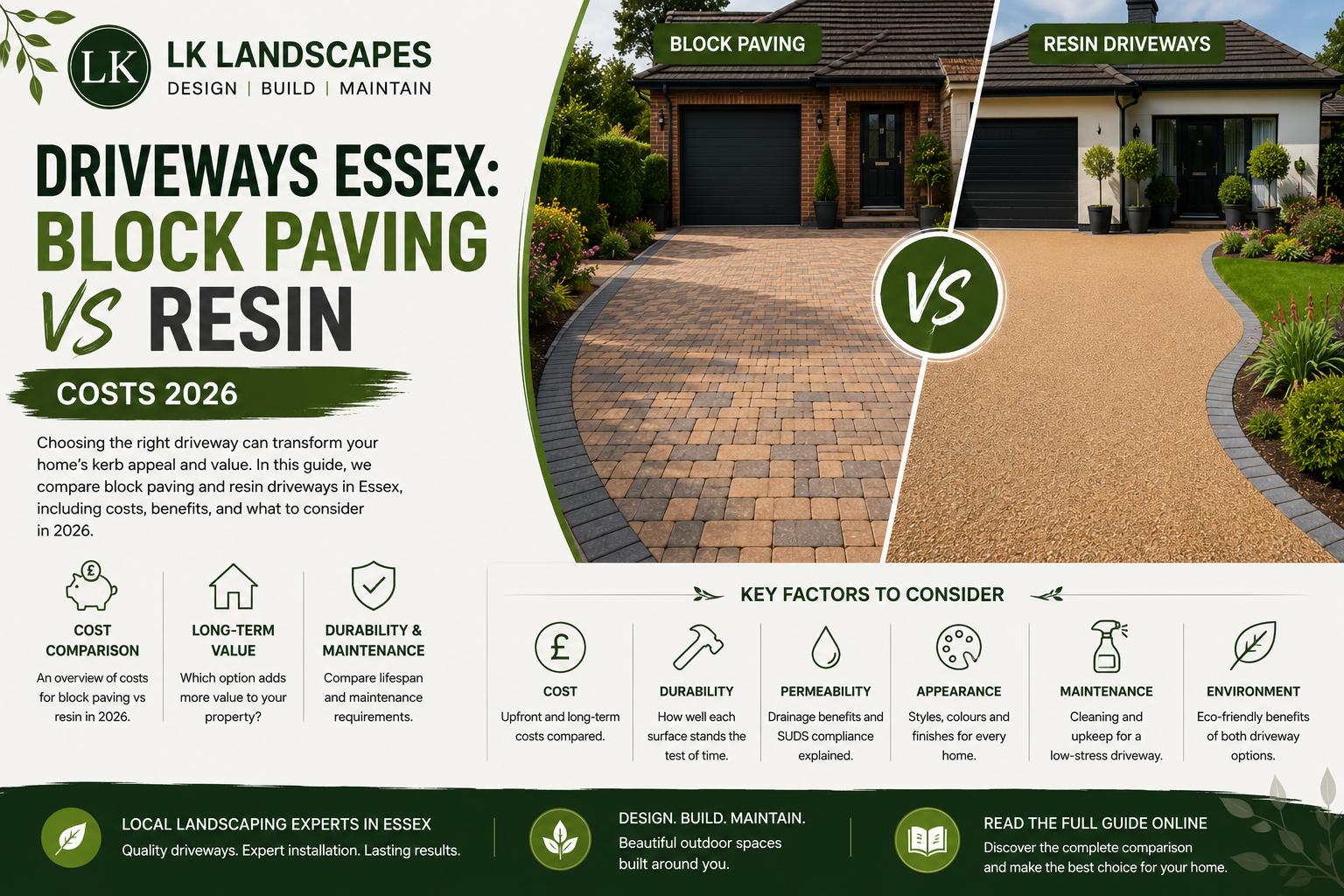
A tired, cracked driveway is one of the first things a visitor or a buyer notices. Replacing it is also one of the few garden projects with a clear, calculable return, since a new driveway can add real value while solving parking problems for good. The two most requested options across Maldon, Tiptree and Colchester are block paving and resin bound surfacing.
This guide compares both in detail, covers the drainage rules that apply to every Essex driveway project, and explains what actually determines how long a new driveway lasts.
Block Paving: Proven, Repairable, Versatile
Block paving has been the default UK driveway choice for decades, and for good reason. Individual blocks can be lifted and relaid if one gets damaged or stained, which is not possible with a poured surface. Pattern and colour options are extensive, from herringbone brick to natural stone setts.
Properly laid on the correct sub-base, block paving lasts 20 years or more. The main upkeep is occasional re-sanding of the joints and pressure washing to stop weed growth.
Block Paving Patterns and Materials
Concrete block paving remains the most affordable option and comes in a wide range of colours and finishes, including riven and textured surfaces designed to resemble natural stone. Clay pavers cost more but hold colour better over decades, since the colour runs through the material rather than sitting as a surface finish. Natural stone setts, typically granite or sandstone, sit at the top of the price range and suit period or high-end properties.
Herringbone patterns are generally recommended for driveways specifically because the interlocking layout resists the sideways movement caused by turning wheels far better than a simple stretcher bond pattern, which is more suited to pedestrian paths.
Block Paving Maintenance Over Time
Joint sand between blocks gradually washes out over several years, particularly on a slope or where a driveway sees heavy rain runoff. Re-sanding every few years keeps blocks locked together and prevents individual blocks from rocking or shifting under vehicle weight. A jet wash once or twice a year, followed by resanding where needed, is normally enough to keep a block paved driveway looking close to new for its full lifespan.
Resin Bound Driveways: Smooth, Permeable, Low Maintenance
Resin bound surfacing mixes stone aggregate with a clear resin, laid to give a smooth, seamless finish. It is naturally permeable, which matters more than most homeowners realise, and it resists weeds without the joint lines that block paving has.
Resin costs more per square metre than standard block paving but needs almost no ongoing maintenance beyond an occasional sweep and rinse.
Resin Bound vs Resin Bonded: An Important Distinction
These two terms are often confused but describe different products. Resin bound surfacing mixes aggregate fully through the resin before laying, creating a smooth, permeable, textured finish that is trowelled level. Resin bonded surfacing instead scatters loose stone onto a layer of resin already applied to the base, leaving a gritty, non-permeable texture that is more prone to stones coming loose over time. For driveways, resin bound is almost always the better long-term choice, and it is worth confirming with any contractor which method they are actually quoting for.
How Long Does a Resin Driveway Really Last
Quality resin bound driveways typically last 15 to 25 years, though the exact figure depends heavily on installation quality. UV-stable resin is essential to stop yellowing in direct sun, and the correct resin-to-stone ratio prevents the surface becoming brittle or, at the other extreme, staying slightly tacky in hot weather. This is a product where installer experience affects the outcome more than with block paving, since resin is mixed and applied by hand on site.
Cost and Durability Comparison
| Factor | Block Paving | Resin Bound |
| Relative cost | Lower to mid | Mid to higher |
| Repairability | Individual blocks replaceable | Patch repairs less seamless |
| Weed resistance | Needs joint maintenance | Naturally weed resistant |
| Permeability | Depends on laying pattern | Naturally permeable |
| Typical lifespan | 20+ years | 15-25 years |
| Installation skill sensitivity | Moderate | High |
SUDS Rules: Why Drainage Matters for Your New Driveway
Since 2008, any new or replacement driveway over 5 square metres laid with a non-permeable surface has needed planning permission unless rainwater is directed to a permeable area or a soakaway. This is part of the Sustainable Drainage rules designed to reduce surface water flooding. Permeable block paving and resin bound surfacing both typically meet this requirement without extra permission. Full detail is available from the Planning Portal’s guidance on driveways, and Essex County Council, as the local lead flood authority, publishes further guidance on sustainable drainage for developments across the county.
What Makes a Surface Permeable in Practice
For block paving, permeability comes from either open, gravel-filled joints that let water pass through into a permeable sub-base, or from permeable block units designed with built-in drainage channels. For resin bound surfacing, permeability is inherent to the material itself, since the open structure of the bound stone lets water pass directly through the surface and into a permeable sub-base below. Getting the sub-base right is just as important as the surface choice, since a permeable surface laid over an impermeable sub-base defeats the purpose.
Sub-Base: The Part That Actually Determines Lifespan
The surface material gets all the attention, but the sub-base underneath is what stops a driveway cracking, sinking or rutting under vehicle weight. A properly specified sub-base for a domestic driveway typically means at least 150mm of compacted MOT Type 3 permeable stone, or Type 1 where a non-permeable build-up is being used with separate drainage. Ground conditions vary significantly across Essex, from heavier clay soils inland around Maldon to lighter, sandier ground nearer the coast at Tollesbury, and sub-base depth should be adjusted accordingly rather than applied as a one-size-fits-all figure.
Edging, Drainage Channels and Finishing Details
A driveway’s edges take more structural strain than the main surface, particularly where vehicles turn or where the drive meets the road. Concrete haunching behind edge blocks or a resin bound border helps stop lateral movement over time. Linear drainage channels set into the surface, positioned to catch runoff before it reaches a garage or house wall, are worth planning at the design stage rather than adding afterwards, since retrofitting drainage into a finished driveway is far more disruptive.
Pairing a New Driveway with the Rest of the Garden
A driveway rarely sits in isolation. Many customers replace the drive at the same time as adding garden fencing along the boundary, or matching the surface into a new patio and path around the side of the house so materials feel consistent front to back. If brick detailing or a low wall is part of the plan, our outdoor brickwork team can tie it all together in one project. Where a front garden also needs planting or a wider redesign around the new driveway, our garden landscaping service covers that as part of the same visit.
What Actually Drives Driveway Cost Up or Down
Beyond the surface material itself, several factors move the final price of a driveway project. Removal of an existing surface, particularly a thick, old concrete slab or deeply rooted tarmac, adds significant labour and disposal cost compared with laying over cleared ground or a soft landscaped area. Ground conditions play a role too, since the heavier clay soils found inland around Maldon typically need more excavation depth and compaction effort for a stable sub-base than the lighter, more free-draining ground closer to the coast around Tiptree and Tollesbury.
Driveway shape and edge detailing also affect price. A simple rectangular drive is more cost-efficient per square metre than one with curves, multiple levels, or intricate border detailing in a contrasting material. Access for delivery vehicles and any need to protect existing boundary walls, gates or planting during the works can add time as well. As with any groundworks project, it’s worth asking a contractor to itemise these factors in a quote rather than accepting a single lump-sum figure that makes it hard to see where the cost is actually going.
Preparing for a Driveway Replacement
Removing an old driveway surface, particularly concrete or tarmac, generates a significant amount of waste that needs proper disposal, and it’s worth confirming with any contractor how this is handled and whether it’s included in the quoted price. Access for skips or muck-away lorries should be considered ahead of time, especially on narrower Essex streets where kerbside parking restrictions may apply during the works. Homeowners with existing planting or boundary features near the driveway edge should flag these before groundwork starts, since excavation for a new sub-base typically extends slightly beyond the finished surface edge.
Seasonal Timing for Driveway Projects
Driveway installation can go ahead through most of the year, though very wet or frozen ground can delay excavation and sub-base compaction. Resin bound surfacing specifically needs a minimum ambient temperature during curing, so very cold snaps in deep winter can push installation dates back by a day or two where a contractor is working to the manufacturer’s application guidelines. Spring and summer remain the busiest booking periods across Essex, so planning ahead for these months is worth doing early.
Choosing a Driveway Contractor in Essex
Driveway quotes can vary significantly for what looks like the same job on paper, and the difference is almost always in the sub-base specification rather than the surface material. When comparing quotes, ask for the sub-base depth and stone type in writing, whether drainage falls have been calculated, and how edge restraints will be installed. For resin bound driveways specifically, ask which resin brand is being used and whether it carries a manufacturer warranty, since resin quality and mixing ratios vary between suppliers and directly affect how the surface performs over time.
A reputable local contractor should be happy to explain groundwork in detail rather than moving straight to colour and finish options, since the invisible parts of a driveway are what determine whether it needs replacing again in five years or twenty.
Frequently Asked Questions
Is resin or block paving cheaper for an Essex driveway? Block paving usually has a lower starting cost per square metre. Resin costs more upfront but needs less maintenance over time, so lifetime cost can even out depending on driveway size.
Do I need planning permission for a new driveway? Only if the surface is non-permeable and larger than 5 square metres without drainage to a permeable area. Permeable block paving and resin bound surfacing generally avoid this requirement.
How long does a driveway installation take? A standard domestic driveway typically takes 3 to 7 days depending on size, ground conditions and whether the old surface needs full removal.
Can weeds grow through resin bound driveways? Weed growth is rare with resin bound surfacing because there are no joint lines for seeds to establish in, unlike block paving where gaps between units can allow weed growth if joints are not maintained.
Will a resin driveway crack like tarmac or concrete? Resin bound surfacing has more natural flexibility than poured concrete or tarmac, which reduces the risk of the cracking associated with ground movement or frost. It is not immune to damage from very heavy or repeated point loads, so weight limits are worth discussing for anything beyond standard domestic vehicles.
Can I park a caravan or motorhome on a resin or block paved driveway? Both surfaces can handle this provided the sub-base has been specified for the additional weight at the design stage. This is worth flagging with your contractor before installation rather than after, since sub-base depth is not something that can be corrected easily afterwards.
Driveways Across North Essex: Local Considerations
Ground conditions vary noticeably across the areas we cover. Maldon and Tiptree sit on heavier clay-based soil, which holds water for longer after rain and generally needs a deeper, well-compacted sub-base to avoid long-term settlement or rutting under vehicle weight. Coastal and estuary-adjacent areas like Heybridge and Tollesbury tend to have lighter, more free-draining ground, which can simplify drainage design but sometimes needs additional compaction effort since looser soil can shift more under load if not properly consolidated during construction.
Colchester’s mix of older properties and newer developments also brings a planning consideration worth flagging: driveways on properties within a conservation area, or those affecting a listed building’s setting, may face additional restrictions on materials or surface changes even where the SUDS permeability rules are otherwise met. Checking with Colchester City Council or Maldon District Council before finalising a design avoids delays once work is due to start.
Ready for a New Driveway?
Whether it is block paving, resin, or a mix of both with brick edging, the sub-base is what determines how long a driveway lasts, not just the surface material. LK Landscapes has installed driveways across North Essex for years and can talk you through the right option for your ground conditions. Contact us for a free quote.