
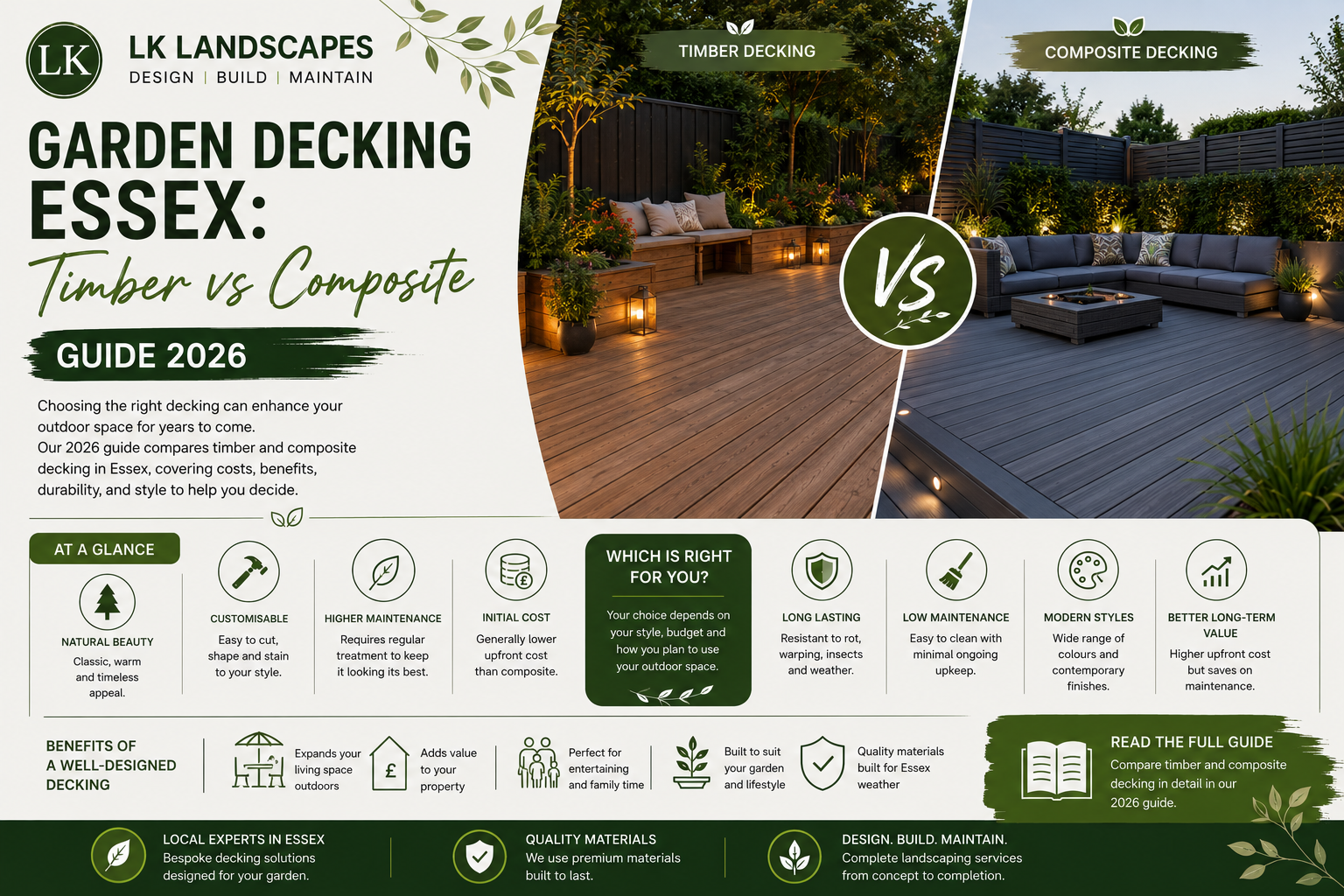
A deck changes how a garden gets used. It turns a patch of grass into a dining space, a spot for morning coffee, or a raised area that solves an awkward slope. The question most homeowners across Maldon, Heybridge, Tollesbury and Colchester ask before booking a quote is simple: timber or composite?
This guide walks through both materials in detail, what they cost to install and maintain in Essex conditions, how long each realistically lasts, and the planning rules that apply before work starts.
Timber Decking: Natural Look, Regular Upkeep
Timber decking still wins on first impressions. Softwood and hardwood boards bring warmth that manufactured materials struggle to match, and the upfront cost is lower than composite.
The trade off is maintenance. Timber needs cleaning, re-oiling or staining most years, and it can warp, splinter or trap algae in a damp Essex autumn. Pressure-treated softwood typically lasts 10 to 15 years with upkeep; hardwood such as oak or balau can go well beyond that.
Softwood vs Hardwood Timber
Not all timber decking behaves the same way. Pressure-treated softwood, usually pine or spruce, is the most common and most affordable option. It takes stain and oil well, but the wood is softer and more prone to surface scuffing over time.
Hardwood species such as oak, balau and ipe cost more per square metre but bring far greater density and natural resistance to rot and insects. A well-installed hardwood deck can outlast two or three re-builds of a softwood equivalent, which matters if the garden is a long-term family space rather than a short-term fix before a house sale.
Annual Maintenance Timber Actually Needs
A realistic yearly routine for timber decking includes a spring clean with a stiff brush and deck cleaner to remove winter algae, a check for loose or raised screws before the summer season, and re-oiling or re-staining every one to two years depending on sun exposure and foot traffic. Boards facing south or getting heavy shade both wear differently, so a full deck rarely ages evenly.
Skipping this routine is the single biggest reason timber decks fail early. Water gets into unsealed grain, boards cup or split, and what should have been a 15-year deck becomes a 6 or 7-year replacement job.
Composite Decking: Higher Upfront Cost, Lower Effort
Composite boards blend recycled wood fibre with plastic. They do not rot, splinter or need staining, and most products carry a 20 to 25 year warranty. Colour stays consistent through wet Essex winters, and slip resistance is generally better underfoot.
The catch is price. Composite typically costs 30 to 50 percent more than timber to install. For homeowners planning to stay put for a decade or more, the lower lifetime maintenance often balances that out.
What Composite Is Actually Made Of
Most composite boards on the market are either capped or uncapped. Capped composite has a protective plastic shell wrapped around a wood-plastic core, giving it better stain and fade resistance. Uncapped composite is cheaper but can absorb moisture at cut edges over time if those edges are not properly finished during installation. This detail is easy for homeowners to miss when comparing quotes on price alone, but it has a real effect on how the deck looks after five winters.
Composite Maintenance, Realistically
Composite is marketed as maintenance-free, which oversells it slightly. In practice, an occasional wash with warm soapy water and a soft brush keeps boards looking new, and leaves or debris trapped between boards should be cleared before they hold moisture against the surface. There is no oiling, staining or sanding required, which is where the real time saving comes from compared with timber.
Cost Comparison at a Glance
| Factor | Timber | Composite |
| Upfront cost | Lower | Higher |
| Annual maintenance | Cleaning, oiling/staining | Occasional wash |
| Typical lifespan | 10-15 years | 20-25+ years |
| Slip resistance (wet) | Moderate | Good |
| Warranty (typical) | Rare or short | 20-25 years |
| Colour consistency over time | Fades, needs re-staining | Stable |
Do You Need Planning Permission for Decking in Essex?
Most raised decks under 30cm high and covering less than 50 percent of the garden fall under permitted development and do not need planning permission. Anything higher, or on a listed building, usually does. Always check with your local planning authority before work starts, and see the government’s own guidance on the Planning Portal for the current rules. Maldon District Council and Colchester City Council can also confirm local restrictions where a property sits in a conservation area.
Choosing a Timber or Composite Deck Board Size
Board width and thickness affect both appearance and structural spacing. Wider boards, typically 140mm to 150mm, show fewer joints and suit larger, open patios, while narrower boards around 90mm to 120mm are often used for detailed patterns such as herringbone or picture-frame borders. Thicker boards, generally 25mm to 28mm for composite, allow for longer joist spans and reduce the flex felt underfoot.
Substructure: Why the Frame Matters More Than the Boards
Whichever surface material is chosen, the joists and frame underneath determine how long the deck stays flat, level and free of squeaks. Timber joists should be pressure-treated to at least Use Class 4 where they sit close to ground level, and joist spacing needs to match the board manufacturer’s specification, since composite boards typically need closer joist centres than timber to avoid sagging. Ground contact posts set in concrete, correct fall away from the house for drainage, and ventilation underneath the deck to stop trapped moisture are the details that separate a deck lasting 20 years from one needing early repair.
What Fits Your Garden Best
A raised deck works well where a garden slopes away from the house, since it creates a level, usable platform without groundwork on the lower section. A ground-level deck suits a flat plot and blends more naturally into a wider garden landscaping scheme, especially where it sits alongside a new patio or path.
Many customers also combine decking with new fencing to frame the space and add privacy, which is worth planning at the same time rather than as a separate project later. Where a garden also needs level changes, steps or a retaining wall to manage a slope, our garden construction team can design the deck and the groundwork as one connected project rather than two separate jobs that need to line up afterwards.
Timber vs Composite: Which Suits Which Household
Families with young children or pets often lean toward composite for its consistent slip resistance and lack of splinters. Homeowners who enjoy seasonal upkeep as part of garden care, or who want the specific warmth of real wood grain, are frequently happier with timber, particularly hardwood species that need less frequent treatment than softwood. Rental properties and holiday lets tend to favour composite purely because there is no ongoing maintenance schedule to manage between tenancies.
Design Considerations: Colour, Layout and Lighting
Composite ranges now come in a wide spread of tones, from pale grey and driftwood shades through to deep brown and charcoal, which makes matching a deck to existing brickwork or fencing straightforward. Timber, by contrast, changes colour naturally as it weathers unless it is regularly treated, so the finish chosen at installation is really only the starting point.
Recessed deck lighting along step edges or board joints adds both a practical safety element for evening use and a finished, considered look. Low-voltage LED strip lighting is the most common choice, wired in during construction so cabling stays hidden beneath the boards.
What Actually Drives Decking Cost Up or Down
Beyond the choice of timber or composite, several factors move the final price more than homeowners often expect. Deck height matters: a raised deck needs a full sub-structure of posts, beams and often a balustrade for safety, which adds materially more labour and material than a ground-level deck sitting on joists close to grade. Ground conditions affect groundwork time too; the heavier clay soils common inland around Maldon and Colchester can need more preparation for stable post footings than the lighter, sandier ground nearer the coast around Tollesbury.
Access is another overlooked factor. A garden reachable only through a narrow side gate means materials have to be carried in by hand rather than moved directly by trolley or small machinery, which adds labour time that a wider, more accessible plot would not incur. Finally, custom shapes, built-in seating, integrated lighting and steps between deck levels all add cost individually, so it’s worth deciding early which of these are must-haves versus nice-to-haves when a quote is being scoped.
Preparing Your Garden Before Installation Starts
A little preparation before the fitting team arrives keeps a decking project on schedule. Clearing the area of furniture, plants in the footprint and any existing structures gives clear access for groundwork. Where a deck replaces an old patio or lawn area, checking for buried services such as drainage pipes or cabling in advance avoids delays once digging starts. For sloped gardens, it’s worth confirming access for materials and any machinery needed to move soil, since narrow side access common on many Essex terraced and semi-detached plots can affect how groundwork is carried out.
Seasonal Timing for Decking Projects
While decking can be installed at almost any time of year, spring and early summer bookings tend to fill up fastest, since most homeowners want the deck ready for the warmer months. Booking in autumn or winter often means a shorter wait for a fitting slot, and dry, cold weather causes no issues for either timber or composite installation. The main seasonal factor to plan around is ground saturation; very wet, waterlogged soil after prolonged rain can delay groundwork regardless of the time of year.
Choosing a Decking Contractor in Essex
Not all decking installers work to the same standard, and the frame beneath the boards is where quality differences show up years later rather than immediately. When comparing quotes, it’s worth asking specifically about joist spacing, whether posts are set in concrete, what timber treatment class is used for ground-contact elements, and whether the quote includes a damp-proof membrane where the deck meets the house. A detailed, itemised quote that answers these questions is generally a better sign than the cheapest headline price.
Checking recent local project photos, and asking whether the installer works to the board manufacturer’s fitting specification, particularly for composite where warranties can be voided by incorrect joist spacing, is worth the extra few minutes before booking.
Frequently Asked Questions
How long does composite decking last compared to timber? Composite typically lasts 20 to 25 years or more with minimal upkeep, roughly double a well-maintained softwood timber deck.
Can decking be installed in winter? Yes. Dry, cold weather is fine for installation. Heavy rain and waterlogged ground are the main things that cause delays.
Does decking add value to a home? Well-built decking that suits the size and style of the property is generally seen as a positive by buyers, particularly when it extends usable outdoor space, as covered in our piece on how landscaping boosts home value in Essex.
Is composite decking slippery when wet? Most composite boards are manufactured with a textured, grooved surface specifically to improve grip in wet conditions, and generally perform better than smooth timber in this respect. Standing water and algae build-up can still reduce grip on any decking material, so regular cleaning matters for both.
Can I mix timber and composite in one project? Yes, some homeowners use composite for the main deck surface and timber for framing details, steps or planters where the natural finish is more visible. This works well provided the structural elements are specified correctly for each material.
How much does garden decking cost in Essex? Costs vary with size, board choice, ground preparation and whether the deck is raised. A site visit is the most accurate way to price a project, since ground conditions across Essex, from clay-heavy plots to sandier coastal soil near Tollesbury, affect groundwork requirements.
Decking Across North Essex: Local Considerations
Coastal locations such as Tollesbury and Heybridge bring a specific challenge that inland gardens in Maldon and Colchester don’t face to the same degree: salt-laden air. Salt exposure can accelerate corrosion in cheaper fixings and screws, so marine-grade or stainless steel fittings are worth specifying for coastal properties even where they add a modest cost. Composite boards generally handle salt air without issue, while timber benefits from slightly more frequent treatment in these locations to protect against the combined effects of salt and damp.
Inland gardens tend to deal more with heavier clay soil, which retains water for longer after rain. This makes proper drainage and ventilation beneath a deck even more important, since standing water trapped under a low-level deck built on clay can encourage rot in timber joists faster than on a free-draining, sandier plot. A short site visit is generally the only reliable way to judge which of these factors applies to a specific garden, since soil type and exposure can vary even between neighbouring streets.
Getting the Right Deck for Your Garden
Timber suits homeowners who want a lower entry cost and do not mind seasonal maintenance. Composite suits anyone who wants a deck to look the same in year fifteen as it did in year one. Either way, the base and joists matter more than the boards themselves, which is where experienced fitting makes the real difference.
LK Landscapes has been building decking across North Essex since 2005.Get in touch for a free, no-obligation quote on your garden decking project.