
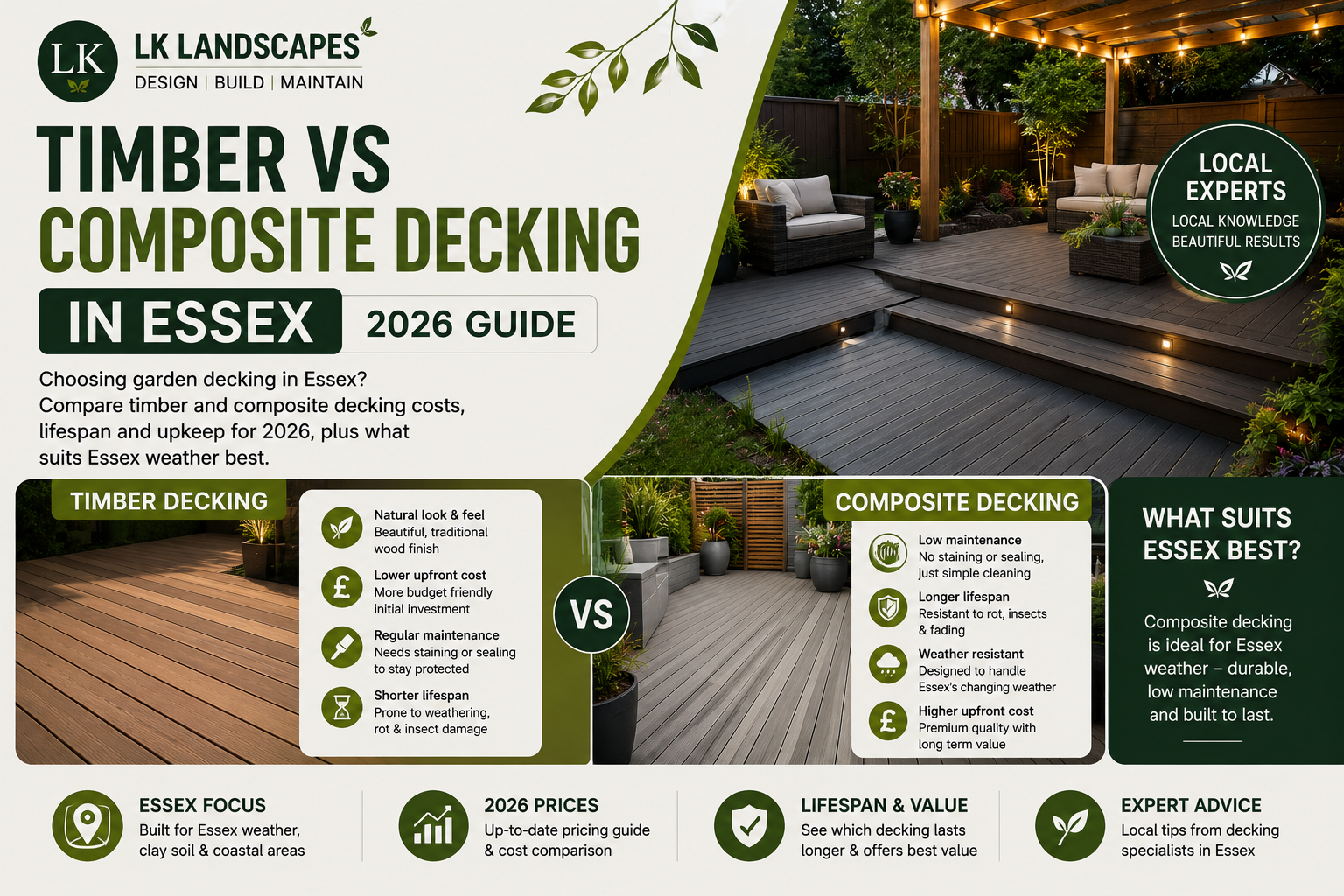
A deck that looks fantastic in its first summer but needs sanding, staining and re treating every year is not the low upkeep outdoor space most homeowners picture when they start planning. Choosing decking in Essex is really a choice between upfront cost and long term maintenance, and the right answer depends on how you actually want to spend your weekends.
At LK Landscapes our decking services cover design and installation across Maldon, Heybridge, Tollesbury, Tiptree and Colchester, and this is consistently one of the first questions homeowners ask us before we even talk about layout or size. Here is a straightforward, honest comparison to help you decide.
What Makes Essex Gardens Different for Decking
Essex sees its fair share of damp autumns and mild, wet winters, and gardens near the coast around Maldon and Tollesbury deal with salt laden air that can accelerate weathering on untreated timber. Decking here needs to cope with moisture, occasional standing water on heavier clay soil, and a fair amount of shade in older, tree lined gardens around Colchester.
None of this rules out timber decking. It simply means the type of timber, the quality of the sub frame and the ongoing care routine matter more here than they might in a drier part of the country.
Timber Decking: Natural Look, Real Maintenance
Timber decking remains popular for good reason. It has a warm, natural appearance that suits both traditional and contemporary gardens, it is generally cheaper to install than composite, and it can be sanded or refinished if it gets scuffed rather than needing a full replacement.
Typical 2026 cost: softwood decking usually runs from £70 to £130 per square metre installed, while hardwood options such as oak or ipe can reach £150 to £250 per square metre. A standard 20 square metre deck in pressure treated softwood typically comes to around £2,000 to £3,000 fully fitted.
The trade off is upkeep. Softwood decking needs treating every one to two years to prevent rot, algae and slipperiness, particularly in shaded or coastal Essex gardens where moisture lingers longer. Hardwood is more resilient but still benefits from an annual oiling to keep its colour and prevent silvering.
Composite Decking: Higher Upfront Cost, Lower Ongoing Effort
Composite decking is made from a mix of recycled wood fibre and plastic, and it has become the go to choice for homeowners across Essex who want the look of decking without the annual maintenance routine.
Typical 2026 cost: around £100 to £200 per square metre installed, depending on board grade. Entry level hollow boards sit at the lower end, while premium capped composite boards from established brands sit toward the top. A 20 square metre composite deck typically costs £2,800 to £4,500 fully installed.
Composite decking does not rot, splinter or need staining, and modern capped boards resist fading and staining far better than earlier generations of composite products. It also performs well in the damp, shaded conditions found in many mature Essex gardens, since it will not develop the algae growth that untreated softwood is prone to. The main downside is the higher upfront cost and a look that, while much improved over older composite products, some homeowners still feel does not quite match natural timber.
Comparing the Two at a Glance
| Feature | Timber Decking | Composite Decking |
| Typical cost per m² (2026) | £70 to £250 depending on species | £100 to £200 |
| Lifespan | 10 to 25 years depending on care | 20 to 30 years |
| Annual maintenance | Treating, staining, occasional sanding | Occasional wash, no treatment needed |
| Performance in damp shade | Needs more frequent treatment | Naturally more resistant |
| Look and feel | Natural warmth, ages with character | Consistent, uniform, modern |
The Sub Frame Matters as Much as the Boards
Whichever decking you choose, the structure underneath it determines how long the deck actually lasts. A frame built from untreated or poor quality timber will rot long before the boards on top show any sign of wear, which is a common cause of decks needing full replacement after only a few years.
For composite decking especially, we recommend a treated timber or composite joist system that will not rot beneath boards that are themselves designed to last decades. It is a small extra cost that avoids paying for the same deck twice within its expected lifespan. Proper ventilation beneath the deck, correct joist spacing and a slight fall away from the house to shed rainwater are all details that separate a deck built to last from one that will need attention within a few years.
Design Considerations for Essex Gardens
Decking works particularly well on sloped or uneven gardens, which are common on properties around Tiptree and the outskirts of Colchester, since it can be built level regardless of what the ground beneath is doing. Raised decking also creates a clear, dry transition point from the house into the garden, which suits homes prone to slightly boggy lawns after heavy rain.
Multi level decking is a popular choice for larger gardens, using changes in height to separate a dining area from a relaxed seating space, while built in planters and integrated lighting extend how usable the space feels into the evening. For smaller gardens in Maldon’s more compact terraces, a single well proportioned deck with built in bench seating around the edge often makes better use of space than a deck plus separate freestanding furniture.
Decking is also a popular addition alongside a shed or gazebo, giving covered and open outdoor space that work together.
Do You Need Planning Permission for Decking in Essex?
Most garden decking falls under permitted development and does not need planning permission, provided it meets a few conditions. Decking that sits less than 300 millimetres above ground level, together with other outbuildings and extensions, generally needs to cover no more than half of the total garden area to stay within permitted development rules.
Raised decking above 300 millimetres, or decking positioned close to a boundary with a neighbouring property, can trigger the need for an application, particularly where privacy or overlooking becomes a factor. Homes in conservation areas around parts of Maldon and Tollesbury may also face additional restrictions. It is always worth a quick check with the local planning department before work begins, and a landscaper who works regularly in your area will usually already know the local requirements.
Colour, Finish and Board Choices
Decking has moved well beyond the standard honey brown boards of a decade ago. Composite decking is now available in a wide range of tones, from warm cedar and walnut shades through to charcoal and driftwood grey, and grooved or embossed wood grain finishes give a far more natural texture underfoot than early composite products managed.
Timber decking offers similar flexibility through staining, allowing everything from a natural oiled finish to a dark, contemporary charcoal stain. Board width and laying direction also change how a space feels. Wider boards laid across the shorter dimension of a garden can make a compact space feel larger, while narrower boards laid lengthways draw the eye toward a specific feature, such as a garden room or a view over open countryside common around the outskirts of Tiptree and Colchester.
Common Mistakes Homeowners Make With Decking Projects
A few recurring issues come up when we are called out to repair decking that was not installed properly the first time around. Insufficient joist spacing is one of the most common, leading to boards that flex or bounce underfoot within a year or two of installation, particularly with composite boards which require closer joist centres than timber in most cases.
Skipping the weed membrane and gravel layer beneath the frame is another shortcut that causes problems later, allowing damp and vegetation to build up unseen beneath the deck. Ignoring drainage falls is a third common issue, since a deck built perfectly flat rather than with a slight fall away from the house can allow water to pool on the boards after heavy rain, accelerating wear regardless of which material was chosen. Asking any contractor how they plan to address joist spacing, ventilation and drainage before work starts is one of the simplest ways to avoid these problems.
Decking and Drainage
Decking is generally more forgiving on drainage than solid paving since gaps between boards allow water through naturally, but the ground beneath still needs proper preparation. A weed suppressant membrane and a layer of gravel beneath the frame stops vegetation growing up through the gaps and helps manage moisture around the joists, which is particularly relevant on the heavier clay soils found across much of North Essex.
Choosing Between Timber and Composite
If you enjoy the process of maintaining a natural material and want the lowest upfront cost, timber decking is a genuinely good choice, particularly softwood for a first deck or a smaller budget. If you want to spend your weekends actually using the garden rather than treating it, and you are comfortable with a higher initial spend for a longer, lower maintenance lifespan, composite is usually the better long term investment.
Many homeowners across Essex also choose a hybrid approach, using composite decking for the main structural areas and timber cladding or edging for a warmer, more natural finish where it will not take the brunt of weather and foot traffic.
If low upkeep is your main priority across the whole garden, our roundup of low maintenance garden ideas for busy homeowners in Maldon covers more than just decking.
A Realistic Maintenance Schedule for Each Material
Knowing what upkeep actually involves helps homeowners choose honestly rather than underestimating the ongoing effort. For softwood timber decking, a yearly clean with a deck cleaner in spring, followed by a fresh coat of stain or oil every one to two years, keeps the boards protected against rot and slipping. Hardwood decking needs a similar yearly clean but can often go two to three years between oiling, since the natural density of the timber resists moisture better than softwood.
Composite decking needs far less. A wash with warm soapy water and a soft brush two or three times a year, particularly after autumn leaf fall when organic matter can build up in the grooves, is usually enough to keep boards looking clean. There is no staining, sealing or sanding required at any point in a composite deck’s life, which is the main reason it appeals to homeowners who want to spend their free time using the garden rather than maintaining it.
Decking Services Across Essex
At LK Landscapes we design and build both timber and composite decking for homeowners across Maldon, Heybridge, Tollesbury, Tiptree and Colchester. We give honest advice on which material actually suits your garden rather than pushing whichever product carries the best margin, and every quote includes a free site visit to check ground conditions, drainage and access before you commit to anything.
Decking pairs naturally with other projects we handle regularly, including garden fencing for privacy around a new seating area and sheds and gazebos for covered outdoor space alongside your deck. If your garden needs wider work before decking goes in, our garden construction services cover groundwork, levelling and drainage too. If you are choosing between decking and a paved area, our guide to patio paving materials in Essex compares the alternatives, and our Essex garden landscaping cost guide covers pricing for driveways, fencing and turfing too.
Frequently Asked Questions
How long does composite decking actually last in Essex weather? Most quality capped composite decking carries a manufacturer warranty of 20 to 25 years and, with the correct sub frame and drainage beneath it, will comfortably reach that lifespan even in damp, shaded Essex gardens.
Is timber decking a bad choice near the coast in Maldon or Tollesbury? Not necessarily, but salt laden air does accelerate weathering, so hardwood or pressure treated softwood with a robust annual treatment routine is recommended over untreated softwood for coastal gardens.
Can decking be installed over an existing patio or uneven ground? Yes, in most cases. Decking is one of the most flexible options for uneven or sloped gardens because the frame can be levelled independently of what lies beneath, though a structural check is still worthwhile on very poor ground.
Does composite decking get hot in direct sun like some plastic products? Modern capped composite boards are designed with heat resistant technology and generally perform similarly to timber underfoot, though very dark colours in full sun will always feel warmer than lighter shades.
How much does a typical garden deck cost in Essex overall? For a standard 20 square metre deck, expect around £2,000 to £3,000 for pressure treated softwood, or £2,800 to £4,500 for composite, fully installed with a proper sub frame and finishing.
Do I need a balustrade or handrail on my deck? Building regulations generally require a balustrade or barrier for decking raised more than 600 millimetres above ground level, both for safety and to meet local building control requirements. This is worth factoring into your budget early, since it typically adds £150 to £350 per linear metre.
Can decking be combined with a patio in the same garden? Yes, and it is a common approach across Essex gardens where the area closest to the house uses paving for a low, solid dining space, while decking further into the garden creates a raised, distinct zone for relaxing or entertaining. It is a practical way to make a single garden feel like several different spaces.
Get a Free Decking Quote
Whether you are leaning toward natural timber or low maintenance composite, the right choice depends on your garden, your budget and how much time you want to spend on upkeep. LK Landscapes offers free, no obligation site visits across Maldon, Tollesbury, Heybridge, Tiptree and Colchester. Call 07857 546454 or get in touch here to talk through your options.