
Standing on a showroom display of paving slabs is nothing like standing in your own garden trying to picture how a material will actually look against your fence, your planting and Essex’s grey winter light. Patio material is one of the biggest decisions in any garden project, and it is also one of the easiest to get wrong when the choice is based on a photo rather than how the surface performs over years, not weeks.
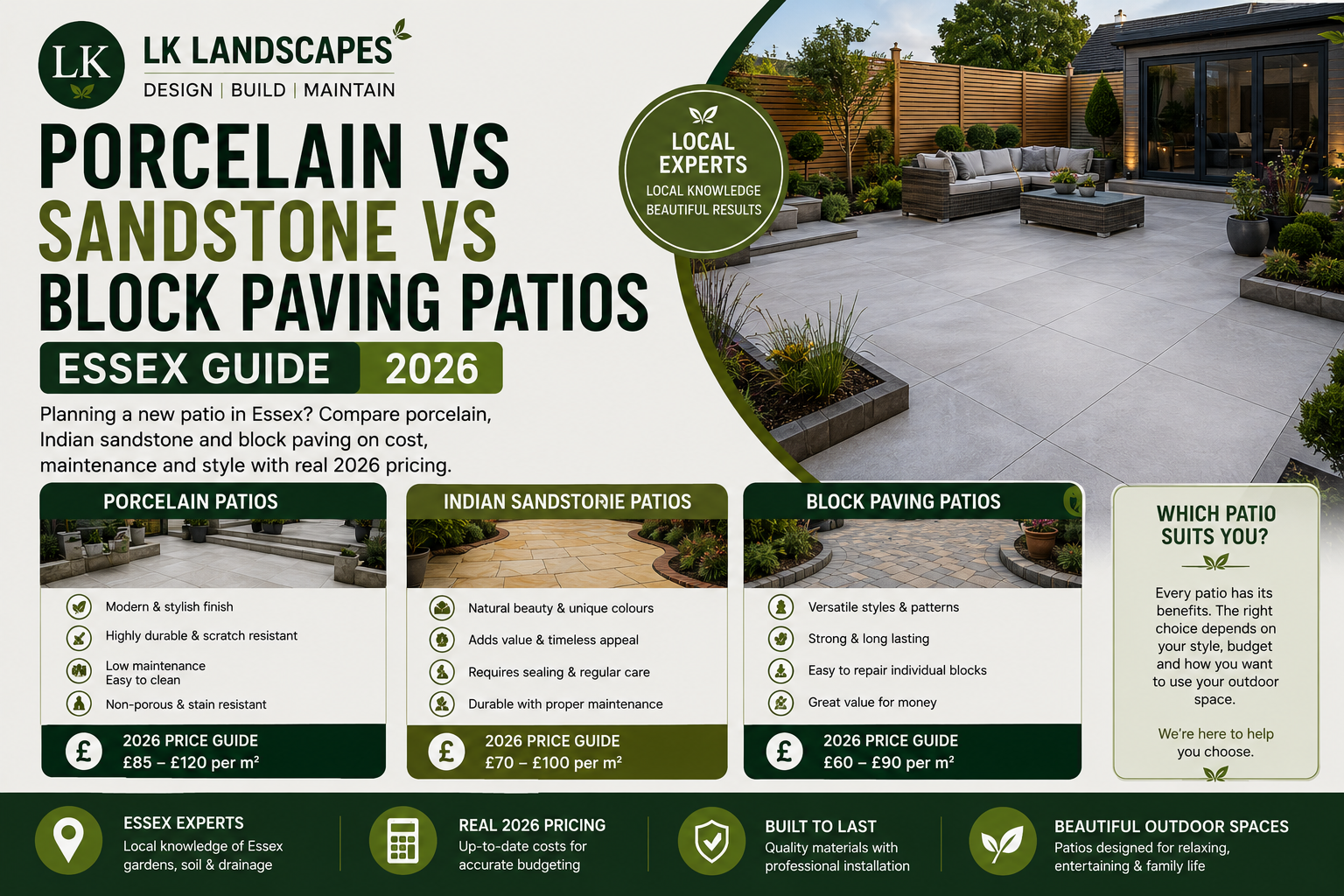
At LK Landscapes our patio and path services cover installation across Maldon, Heybridge, Tollesbury, Tiptree and Colchester, and this guide breaks down what porcelain, Indian sandstone and block paving actually cost in 2026, how each performs in Essex weather, and which one tends to suit different types of garden.
Why Patio Choice Matters Beyond the Look
A patio is one of the most used parts of any garden, carrying furniture, foot traffic and constant exposure to whatever the Essex weather throws at it through the year. The wrong material for your setting can mean a surface that stains, cracks in frost, becomes dangerously slippery when wet, or simply looks tired within a couple of summers.
Drainage matters here too. Any patio over five square metres laid with non permeable materials close to a house generally needs to drain to a lawn, border or soakaway rather than straight into the road system, under the same SuDS principles that apply to driveways.
Indian Sandstone: The Traditional Favourite
Indian sandstone has been the default choice for UK gardens for years, and it remains extremely popular across Essex for its natural, warm appearance and the way it settles into a garden rather than looking artificially uniform.
Typical 2026 cost: around £90 to £160 per square metre fully installed, depending on the calibration and finish chosen. A standard 30 square metre patio typically comes to between £2,700 and £4,800.
Sandstone is naturally riven, meaning each slab has a slightly textured, uneven surface, which gives good grip underfoot even when wet. It is a porous stone, which means it needs sealing every two to three years to resist staining and algae growth, particularly in shaded or damp corners of a garden that get less direct sun through the day.
Porcelain Paving: The Modern Low Maintenance Option
Porcelain has moved from a premium niche product to one of the most requested patio materials across Essex gardens in the last few years, largely because it solves the maintenance issue that comes with natural stone.
Typical 2026 cost: around £100 to £180 per square metre installed. A 30 square metre patio in porcelain typically costs between £3,000 and £5,400.
Porcelain is manufactured to a precise, uniform thickness, which speeds up installation on a well prepared base and gives a crisp, contemporary finish with tight, consistent joints. It is virtually non porous, so it resists staining from barbecues, wine and garden dirt far better than sandstone, and it never needs sealing. It is also frost proof and holds its colour in direct sun, which matters for south facing gardens common across new build developments around Colchester and Tiptree.
Block Paving Patios: Durable and Design Flexible
Block paving is usually associated with driveways, but it is a genuinely good patio option too, particularly for gardens that want to match a paved patio to an existing block paved driveway or path for a consistent look across the whole property.
Typical 2026 cost: around £70 to £130 per square metre installed, similar to a block paved driveway. A 30 square metre patio typically costs between £2,100 and £3,900.
Block paving offers the widest choice of colours and laying patterns of the three options, and individual blocks can be lifted and replaced if damaged, which is a genuine practical advantage over large format porcelain or sandstone slabs. It does require more frequent joint maintenance than porcelain, and the smaller unit size means more visible joints across a large area compared with big format paving.
Comparing the Three at a Glance
| Feature | Indian Sandstone | Porcelain | Block Paving |
| Typical cost per m² (2026) | £90 to £160 | £100 to £180 | £70 to £130 |
| Porosity | Porous, needs sealing | Virtually non porous | Porous jointing, low absorption blocks |
| Maintenance | Reseal every 2 to 3 years | Occasional wash only | Occasional jet wash and joint refresh |
| Slip resistance | Naturally textured, good grip | Textured finishes available | Good, textured surface |
| Best for | Traditional and cottage style gardens | Modern, contemporary gardens | Matching an existing driveway or path |
Getting the Base Right Matters More Than the Slab
As with driveways, the sub base beneath a patio is what determines whether it stays flat and stable for decades or starts to move within a couple of years. A patio dug to the correct depth, with a well compacted MOT Type 1 sub base and an appropriate bedding layer, will outlast one where the surface material alone was the focus of the budget.
This is particularly relevant on the heavier clay soils found across much of North Essex, where an under prepared base is far more likely to lead to slabs lifting, sinking or cracking as the ground moves through wet winters and dry summers. Porcelain in particular needs a fully solid, unyielding bed since its thin, rigid slabs are less forgiving of any movement beneath them than thicker, more flexible sandstone.
Colour and Style Choices for Essex Gardens
Sandstone is available in warm tones such as Raj Green, Autumn Brown and Kandla Grey, all of which suit the mellow brick and weatherboard character common in villages around Tollesbury and Maldon. Porcelain ranges from pale stone effect finishes through to dark charcoal and even realistic wood effect planks, giving a genuinely contemporary edge to newer builds and extensions around Colchester.
Block paving allows for the most creative layouts, from classic herringbone to more elaborate circular feature patterns often used as a focal point near a seating area or fire pit. Many Essex gardens now mix materials deliberately, using porcelain for the main entertaining area closest to the house and a border of contrasting block paving or brick to frame the space and tie it into a driveway or garden wall elsewhere on the property.
If you are planning wider changes to the garden alongside a new patio, our guide on transforming small gardens in Maldon and CM9 has more design ideas for compact plots.
Steps, Edging and Level Changes
Many Essex gardens are not perfectly flat, particularly on sites near the Blackwater estuary or the gently sloping ground around Tiptree and the edges of Colchester. Steps and retaining changes in level are a normal part of patio design here rather than an unusual extra, and they are worth budgeting for from the outset rather than as an afterthought once the main paving is quoted.
Well built steps, matched in material to the main patio, do more than solve a practical level change. They create a natural division between different areas of the garden, such as a raised dining terrace close to the house and a lawn or planting area below it, which is a layout that works particularly well on the more generous plots found in villages surrounding Maldon.
A tidy, well finished patio also does a lot for kerb and garden appeal, a point we explore further in how garden landscaping can boost your home’s value in Essex.
Common Mistakes When Comparing Patio Quotes
Not all patio quotes are comparing like for like, and a few checks help avoid an unpleasant surprise once work is underway. Ask whether excavation depth and sub base specification are included explicitly, since a shallow, under prepared base is the single biggest cause of patios failing early, regardless of which material sits on top.
Confirm whether jointing is included and what type is specified, since traditional sand and cement pointing performs very differently over time compared with modern polymeric jointing compounds, which resist weed growth and washout far better. Check whether the price includes falls for drainage, since a flat patio without a slight gradient away from the house will collect standing water after rain, which accelerates staining and, in cold snaps, increases the risk of frost damage. Finally, ask what happens to excavated soil and old paving, since removal and disposal is sometimes quoted separately and can add a meaningful amount to the final bill if it was not clear from the outset.
Planning Permission and Drainage Rules for Patios
Most patios fall under permitted development and do not require planning permission, but the same SuDS drainage principle that applies to driveways applies here too. A patio larger than five square metres, laid with non permeable materials and positioned close to the house, generally needs to drain to a permeable area such as a lawn or border, or include a soakaway, rather than discharging directly to a hard surface or drain.
In practice this is rarely a difficult requirement to meet on a typical garden patio, since most designs already slope gently toward a lawn or planted border. It is simply worth confirming with your installer that the drainage design has been considered from the outset rather than added as an afterthought once the paving is already down.
Choosing the Right Patio Material for Your Garden
If your home has a traditional or period character, or you want a patio that softens and settles naturally into an established garden, Indian sandstone remains an excellent and well proven choice. If you want a clean, contemporary finish with the lowest possible ongoing maintenance, porcelain is worth the higher upfront investment, particularly for busy households who would rather spend weekends using the garden than sealing it. If you already have block paving elsewhere on the property, or you want maximum design flexibility at a lower cost per square metre, block paving remains a genuinely strong option.
Best Time of Year for Patio Work in Essex
Patio installation can technically happen year round, but spring and early autumn tend to offer the most reliable working conditions across Essex, avoiding both the heaviest winter rain, which can delay excavation and sub base work on clay ground, and the peak summer booking rush when most local landscapers are fully committed weeks in advance.
Booking a patio project in late winter for a spring build is a practical way to secure your preferred installation dates and material before the busiest season begins, particularly if your project is timed around a specific event such as hosting family over summer.
Patio Installation Across Essex
At LK Landscapes we design and install porcelain, Indian sandstone and block paving patios for homeowners throughout Maldon, Heybridge, Tollesbury, Tiptree and Colchester. Every quote starts with a free site visit so we can assess your ground conditions, drainage and levels before recommending a material honestly, rather than defaulting to whichever product happens to be in stock.
A new patio often works well alongside our garden landscaping services for planting and borders around the new space, and our outdoor brickwork services for matching retaining walls, raised beds or steps. If a raised timber area suits your garden better than paving, our timber vs composite decking guide covers the alternative, and our Essex garden landscaping cost guide sets out pricing across every service.
Frequently Asked Questions
Which patio material is best for a garden that gets a lot of shade? Porcelain performs particularly well in shaded, damp corners of a garden since it does not absorb moisture the way sandstone can, which reduces the risk of algae and green staining that shows up quickly on porous stone kept out of direct sun.
Does porcelain paving get slippery when wet? Textured, structured finish porcelain is designed to meet slip resistance standards for outdoor use and performs well in wet conditions. Highly polished porcelain, which is intended for indoor use, should always be avoided for an outdoor patio in the Essex climate.
Can I lay a new patio directly over an old one? It is sometimes possible for like for like materials on a sound existing base, but it is rarely advisable, since it usually raises the finished level in ways that create problems at doorways, and it does not address any underlying sub base issues that may already exist.
How long does a typical 30 square metre patio take to install? Most patios of this size take four to six working days from excavation to finished, jointed surface, depending on ground conditions, whether steps are involved and the complexity of the chosen laying pattern.
Is Indian sandstone or porcelain better value over time? Sandstone typically costs less upfront but needs sealing every few years, which adds ongoing cost and effort. Porcelain costs more initially but needs no sealing, so for homeowners planning to stay in a property long term, the total cost of ownership between the two is often closer than the upfront price suggests.
Can I mix patio materials with a driveway of a different type? Yes, and many Essex homeowners do exactly this, choosing porcelain or sandstone for the patio while keeping a more practical, lower cost surface such as block paving or resin for the driveway. A shared colour palette or a matching edging detail is usually enough to tie the two areas together visually without needing identical materials throughout.
What is the difference between calibrated and non calibrated sandstone? Calibrated sandstone is machine cut to a consistent thickness, which speeds up installation since the installer does not need to manually adjust the mortar bed depth for each slab. Non calibrated sandstone varies more in thickness and costs less, but takes longer to lay properly and is more likely to show inconsistencies in the finished surface if installed by an inexperienced contractor.
Get a Free Patio Quote
Choosing between porcelain, sandstone and block paving comes down to your garden, your budget and how you actually want to use the space. LK Landscapes offers free, no obligation site visits across Maldon, Tollesbury, Heybridge, Tiptree and Colchester. Call 07857 546454 or get in touch here to discuss your patio project.